From Father to Nothing · chapter eight
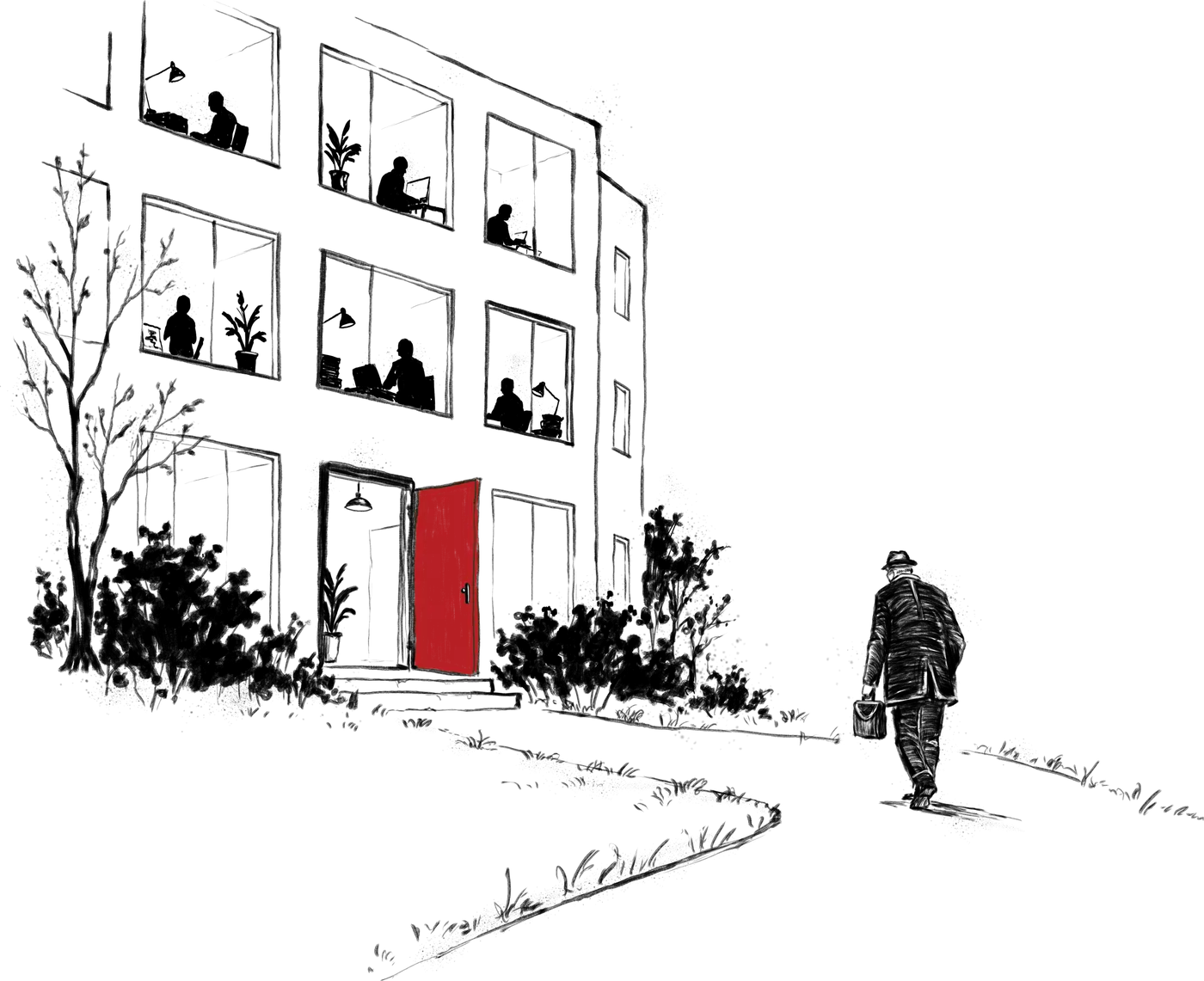
Good Endings
Previously: People We Did Not Choose
I watched my father, and his partners who died before him, drag their businesses on to the very end. No pause, no real handover, no time left to enjoy the fruits of a lifetime’s work.
None of them chose that ending. It simply came. So it goes.
And yet an entrepreneur can always step out. We are not in a falling aeroplane with no way out. We can sell the firm at any time, hand over the management, or let it be. It is just that making the decision is immensely hard.
Two chapters ago I wrote about how to do it in the very worst way. This is the opposite answer. How to leave well, sell well and part well. Good endings.
After success in business, sooner or later comes failure. As strength fades, money saturates and a comfortable life beckons, the hunger and the fire slowly go out. To play this endgame not only with honour, but without destroying the whole of the wealth and the relationships in the family, is extremely hard. Our intuition ignores endings. Otherwise we would probably go mad. A business always ends by ceasing to work. A relationship in the family also ends, either with the death of one of us, or with our parting.
In business, the ending can be a good one. I recognise a good ending by three things. The wealth serves the people, not the people the wealth. People still talk to each other. And the one who left goes on his own way.
Not much is written about good endings. The terrible ones everybody knows. The Dassler brothers parted so completely that one firm became Adidas and Puma, and one town became two camps. Pekka Herlin left the controlling stake in Kone to one son. His siblings learned of it only after his death, and reached an agreement two years later. By splitting up.
A good ending does not make the papers. Nothing in particular happens. There is no fight to fill the tabloid headlines. No drama. Even so, it is not easy.
How to leave?
Jeffrey Sonnenfeld described four ways in which bosses leave. The monarch does not leave until he is carried out. The general leaves reluctantly and plans his return. The ambassador leaves and stays on hand. The governor serves his term and goes off to do something else.
My father left as a monarch. Not because he wanted to. My brother and I had told him fairly plainly that we did not want to take over the operating companies. It made him a little sad. And he did not really know how to step out of the structure himself. There was no management separate from the partners, and the shares were more or less unsellable to anyone outside.
You cannot leave well when there is no way out. The exit is built years in advance. Management that is not a partner. And a share that can be sold.
I have written about being a listening ear. Until I dismiss the successor, I am to support him and speak well of him, whatever I may think. That is the ambassador.
And you need somewhere to go. Whoever does not know what he will do the next morning does not leave. I did not know either. But I am built so that uncertainty does not frighten me. It will work out somehow, and I find myself something to do very quickly. After leaving the management of SMPL I gained the room to devote myself to this book, for instance. To subjects that reach beyond me and beyond my country.
How to sell?
Selling a business that is doing well is harder than closing one that is not. And yet there is only one question. Do I want to sell it, or not? How much is enough? Will it not be worth more tomorrow?
And what is it worth? As much as someone is willing to pay for it. Or as much as it brings me when I fold my arms and do nothing. The founder’s idea often parts company with reality. Expert valuations vary widely. It is better to agree.
Sell while there is something to sell. The worst trap is when the performance of the business is falling and so is your own energy for change. The derelict factories could surely have been sold or let in time.
But a good ending need not be a sale. When a business earns money but is shrinking, it may make sense to let it run its course. Just do not put back into it what it earns.
My father died in the middle of a transaction. In the hardware business we were about to buy out a departing partner. We turned it round, and he bought us out instead.
The core of my father’s business, on the other hand, I wrote off for a few crowns and walked away from. You cut away a piece of a man’s life’s work. But it made no business sense. That too was a good ending. Not for the bicycles and the kitchenware. For everything else. So that we could breathe.
How to part?
Where we are not playing for the same side, it is wiser to part than to stay together in something that does not work. That goes for employees and for partners alike.
With two of you it is simple. Either we agree to sell and divide the pie. Or we do not agree, and the only possible buyer is the other one. The price is then somewhere between zero and infinity.
That is why the rules for parting are written while things are calm. That each of us may leave. And for how much. Once the pitchforks are out, we will not agree even on that.
People can bear even a worse outcome when the process was fair. When they knew in advance what the decision would be based on. And when someone listened to them.
In one American study, the toss of a coin decided which divorcing parents in a custody dispute would go to court and which to a mediator. The mediation took five hours on average. Twelve years later, 28 per cent of the parents who did not live with their children and had been through mediation were seeing them every week. Of those who had gone straight to court, 9 per cent.
It is a study of divorces. But partners of thirty years get divorced too.
We had no mediator. We had long general meetings.
People do not remember the average. They remember the most intense moment and the end. Thirty years of business together will be judged by the last year.
With us, the road was thoroughly unpleasant. The mind filters out bad experiences, so I no longer remember much of what the pain was like. I remember that in the end we all agreed.
And then what?
A good ending does not end with a signature. It ends with what you do afterwards. With the money and with the time.
When a man has been successful in business, he thinks he will be successful at investing too. It is an entirely different game. An entrepreneur is used to the idea that the harder he works, the more he shapes the outcome. He cannot move the market.
The entrepreneur often becomes an angel investor. Or starts trading shares, commodities, whatever. And finds that the money he made in business is not at all hard to lose.
A member of the family I have written about told me how, as a young IT man, he was furious when they sold the automation business. The only business that interested him. The rest was chimneys and old factories. Today he says that if they had handed him his share back then, he would most likely have lost all of it in the dot-com bubble. And he has come to like the chimneys.
I advise my daughter to choose positive-sum games. A profitable business, property that earns rent, a stock index. Active trading is a zero-sum game. What one person makes, another loses. And after fees, a negative-sum one.
If I open a pub and do nothing, I may as well close it straight away. With a stock index it is the other way round. Buy and hold. Here nothing beats anything, by a wide margin. For an entrepreneur that is the hardest thing of all.
It is said that the best results were on the accounts of people who had died. Nobody touched them. The study that is supposed to prove it has never been found. The one that does exist says the same. Of 66,000 American households, the ones that traded most earned least.
We feel that looking at the chart often is better than not looking. It is not. We just feel, for a moment, more in control. Perhaps one day I will write another book about that. About how speculation, and watching a negative-sum game, can pull you in.
Entrust the money to a manager? One question is enough. What motivates him? Earning from managing your money. He will want to show that he is doing something, because we do not pay for passivity. And fees compound much as taxes do.
And time. What money can give me at fifty, it can no longer give me at eighty. The joy of climbing Kilimanjaro will probably not come. It would not come for me even now. Children, in turn, get the most out of it around thirty, not at fifty when they inherit.
How to end well:
Build the exit before you need it. Management that is not a partner. A share that can be sold.
Write the rules for parting while things are calm. Who may leave, and for how much.
Sell while there is something to sell.
The price is not set by what you put in. It is set by whoever pays.
Mind the process. Listen, explain, then decide.
Speak well of whoever came after you.
Speculate with the proceeds as little as possible.
Have somewhere to go.
My father and his partners dragged it on to the end. A good ending is one after which I set out again.